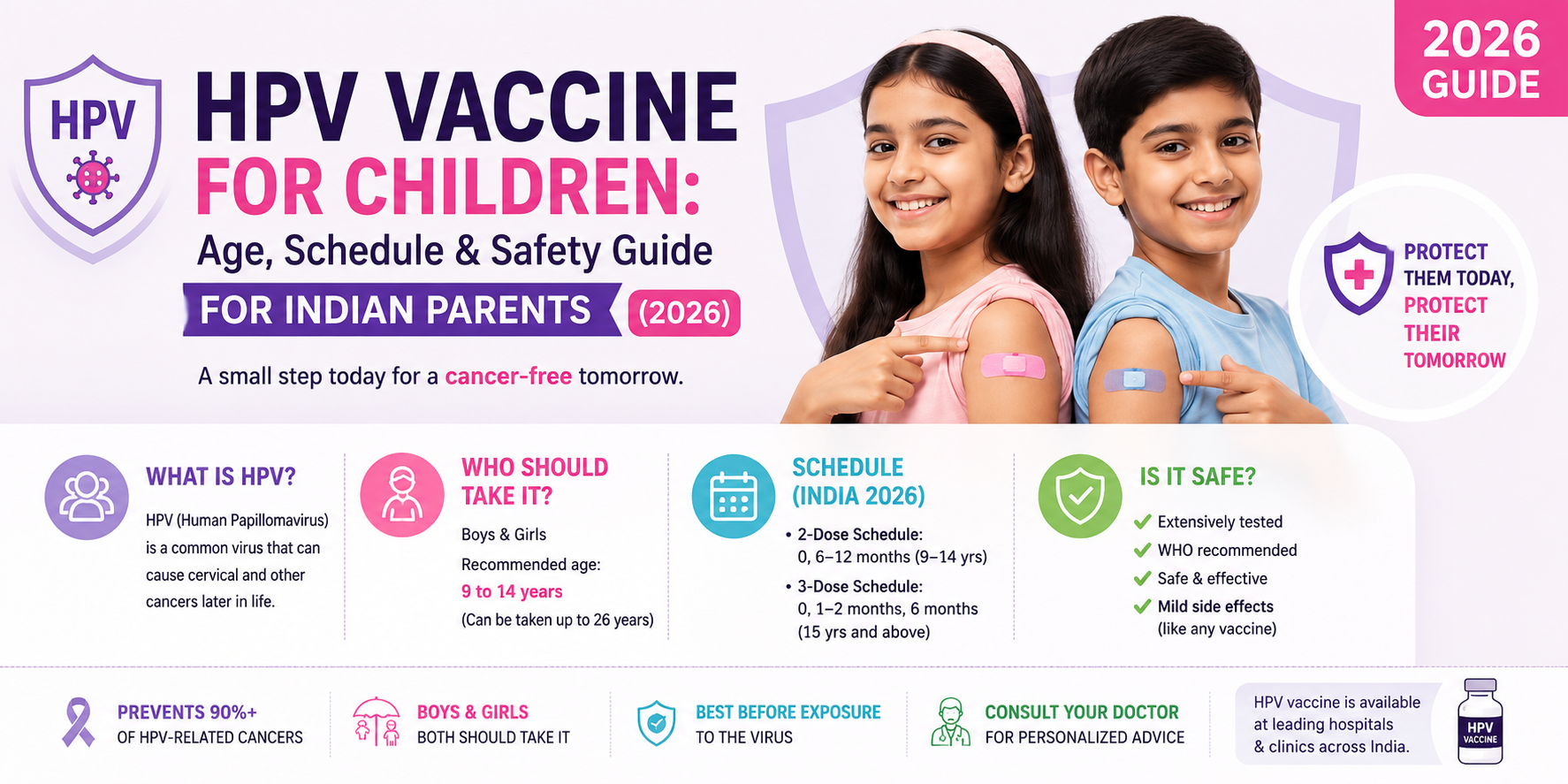
If you've been hearing more about the HPV vaccine lately, you're not imagining it. In February 2026, the central government launched a national campaign to vaccinate every 14-year-old girl in India against HPV, free of cost. It's brought a vaccine that pediatricians have quietly recommended for over a decade into mainstream conversation — and with that comes a flood of questions from parents.
As a pediatrician, this is one of the most important vaccines I discuss with families, and also one of the most misunderstood. Here's what the evidence and current Indian Academy of Pediatrics (IAP) guidelines actually say. (If you're also looking for a complete childhood vaccination schedule, I've covered that.)
Human papillomavirus (HPV) is extremely common and spreads through skin-to-skin contact. Most infections clear on their own, but certain high-risk strains, if they persist for years, can lead to cancer — most notably cervical cancer, but also cancers of the vulva, vagina, anus, penis, and throat, along with genital warts.
In India, cervical cancer is the second most common cancer in women, with roughly 1.2 lakh new cases and close to 80,000 deaths every year. It's also one of the few cancers we can almost entirely prevent — through vaccination before exposure, combined with regular screening later in life.
This is probably the most persistent misconception I hear in clinic. HPV-related throat (oropharyngeal) cancer is now rising faster in men than cervical cancer cases are falling in women, and HPV also causes anal and penile cancers in males.
In India, the nonavalent vaccine (Gardasil-9) is the most clearly established option licensed for boys, for ages 9 to 15. Cost and licensing are real constraints for vaccinating sons, but if you're able to consider it, IAP guidance does support vaccinating boys as well as girls — ask your pediatrician about current options at your child's age.
IAP recommends starting the HPV vaccine series between ages 9 and 14, and there's a genuinely good reason to vaccinate early rather than waiting: younger adolescents mount a stronger immune response and need only two doses, spaced about six months apart. Once a child crosses 15, or has a compromised immune system, the schedule changes to three doses (roughly at 0, 1–2, and 6 months) — more visits, more cost, for comparable protection.
The vaccine works best when given before any HPV exposure, which is exactly why pediatricians push for the 9–14 window rather than waiting for the teenage years. That said, if your daughter is older, it isn't "too late" — catch-up vaccination is recommended up to age 26 for girls who missed the ideal window, and some vaccines are licensed up to age 45.
The campaign was launched by the Prime Minister on 28 February 2026 from Ajmer, Rajasthan, targeting roughly 1.15 crore 14-year-old girls across India with a single dose of Gardasil-4, free of cost at government facilities. Girls turning 15 within 90 days of the launch are also covered under this intensive drive.
A few things worth knowing if your daughter falls in this group:
Three HPV vaccines are commonly used in private practice in India. They differ in strain coverage, who they're licensed for, and price — here's a side-by-side look:
Price: Affordable. (Cervavac is still seeking full WHO prequalification, but has shown comparable immune response to the established vaccines in Indian trials.)
Yes. The HPV vaccine has nearly 20 years of global safety data and more than 500 million doses administered worldwide since 2006. The most common side effects are mild: soreness at the injection site, and a low fever in a small percentage of children. Someadolescents feel briefly dizzy or faint after the shot — this is a known reaction to needles in this age group generally, not specific to HPV vaccination, and is why we ask children to sit or recline for a few minutes after the injection.
Yes. The HPV vaccine has nearly 20 years of global safety data and more than 500 million doses administered worldwide since 2006. The most common side effects are mild: soreness at the injection site, and a low fever in a small percentage of children. Someadolescents feel briefly dizzy or faint after the shot — this is a known reaction to needles in this age group generally, not specific to HPV vaccination, and is why we ask children to sit or recline for a few minutes after the injection.
"My child is too young at 9." Actually, 9–14 is the ideal window — better immune response, and only two doses needed.
"It's only relevant once my child is sexually active." The vaccine has no benefit against infections a person has already been exposed to, which is exactly why earlier vaccination matters more, not less.
"Too many vaccines overload the immune system." A child's immune system handles far more exposure in daily life than a vaccine schedule ever asks of it. The HPV vaccine can safely be given in the same visit as other adolescent vaccines like Tdap.
Is the HPV vaccine free in India? Free for 14-year-old girls under the 2026 national campaign. Outside that, it's available at private clinics as a paid vaccine, with cost depending on the brand chosen. For a full breakdown of which vaccines are free vs paid under the IAP schedule, see.
Can boys get vaccinated in India? Yes, with Gardasil-9, for ages 9–15.
What if my daughter already had the first dose elsewhere — can she switch brands for dose two? Ideally the same vaccine type is used for the full series. Bring her vaccination card to your next visit so this can be checked properly.
Does it need a booster later in life? No booster doses are currently recommended once the primary series is complete.
If you'd like to talk through timing, vaccine choice, or whether your child has missed the ideal window, I see patients for vaccination consultations every evening at my Chembur clinic — happy to help you work out what makes sense for your family.
Dr. Sana Agrawal is a pediatrician based in Chembur, Mumbai, with a clinical focus spanning neonatology, general pediatrics, and child development.