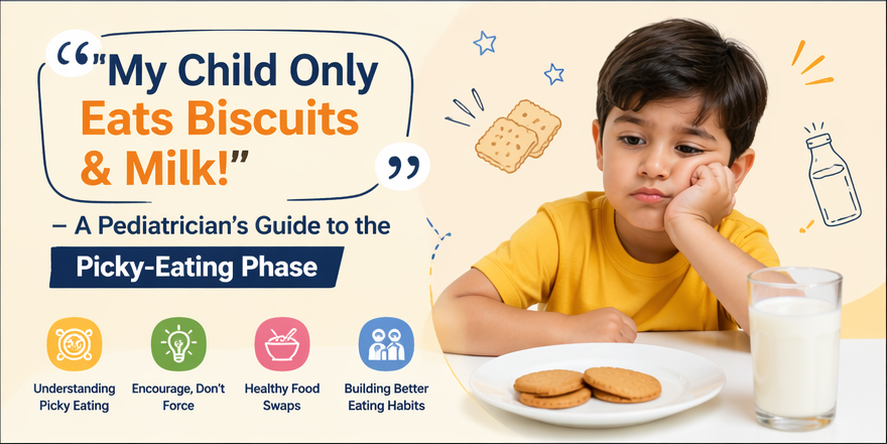
My Child Only Eats Biscuits & Milk!" – A Pediatrician’s Guide to the Picky-Eating Phase
In many Indian households, mealtime is often the most stressful hour of the day. From chasing a toddler around the living room with a bowl of dal-chawal to the constant pressure from elders who think the baby looks "too thin," the "Food Wars" are real.
As a pediatrician practicing in Mumbai, I see many urban parents struggling with this. If your child has suddenly started refusing the healthy upma or roti you’ve prepared and is demanding only "packets" or plain milk, this guide is for you.
1. The "Chubby Baby" Myth
In India, we are culturally conditioned to believe that a "chubby" baby is a healthy baby. When a toddler’s growth naturally slows down after the first year, parents (and grandparents) often panic.
- The Reality: Your child’s stomach is roughly the size of their own fist. They don't need a giant bowl of food to be healthy. If they are active, hitting milestones, and following their growth curve, they are likely getting enough.
2. The "Screen-Feeding" Trap
It’s very common in homes to see a toddler eating while staring at a phone or TV. While this might get the food into their mouth, it’s a "distraction-feeding" habit that does more harm than good.
- Why it’s a problem: The child isn't learning to recognize their "full" signal. This can lead to overeating or a total lack of interest in food textures.
- The Goal: 20 minutes of "Screen-Free" family mealtime. Even if they only eat two spoons, those two spoons were eaten mindfully
3. The "Doodh" Problem
In Indian homes, milk is often seen as a complete meal. I see many toddlers drinking 3-4 big glasses of cow’s milk a day.
- The Pediatrician’s View: Too much milk is the #1 cause of picky eating and iron deficiency (Anemia) in India. Milk fills them up, so they never feel "true hunger" for solid food like sabzi or meat/daal. Limit milk to no more than 400-500ml a day after age one.
4. Indian-Parenting Hacks for Picky Eaters
- The "One-Bite" Rule with Desi Flavours: Don't just give plain boiled veggies. Use mild spices like cumin (jeera), turmeric (haldi), or a little ghee to make food flavorful. Kids often prefer "real" family flavors over bland "baby food."
- Stop the "Chasing": If your child walks away from their high chair or mat, the meal is over. Don't follow them around the house. They need to learn that food happens at the table/mat,not on the go.
- The "Hidden" Nutrition: If they refuse sabzi, grate it into a paratha or blend it into a pasta sauce. However, always keep offering the whole vegetable on the side so they eventually recognize it.
- Involve the Elders: Have a gentle conversation with the grandparents about not giving "hidden" biscuits or chocolates between meals. A small Marie biscuit can ruin a toddler's appetite for lunch!
5. When should you actually be concerned?
While picky eating is usually a phase, as a doctor, I look for "Red Flags" that require a clinic visit:
- Weight Stagnation: If their weight hasn't changed in 4-6 months.
- Constipation: A very common result of a "milk-and-biscuit" diet.
- Lethargy: If the child seems less active or pale (sign of low iron).
- Extreme Aversion: If they gag or vomit when they see certain textures.
A Message to Parents
You are doing a great job. In the age of Instagram "perfect" lunchboxes and Delivery-at-your-doorstep, it’s hard to stay patient. Remember: your job is to provide healthy food; their job is to decide how much to eat.
Is your child's picky eating causing you stress?
Let’s look at their growth chart together. I offer Comprehensive Pediatric Nutrition Analysis- where we check for iron levels and create a realistic Indian meal plan that works for your family.