Let me start by saying this without judgment: almost every parent I see in clinic has used a screen to keep their baby occupied at some point. A YouTube video during a meltdown, a cartoon during feeding, a phone to distract during a doctor's visit — this is the reality of parenting in 2026, and there's no shame in it.
But I do get asked about screens constantly, and the questions parents ask have shifted. It's no longer "is screen time bad?" Most parents already sense the answer. The real questions now are: how bad, exactly? What does it actually do? And is there a safe amount?
Here's what the evidence says — honestly, and without the usual lecture.
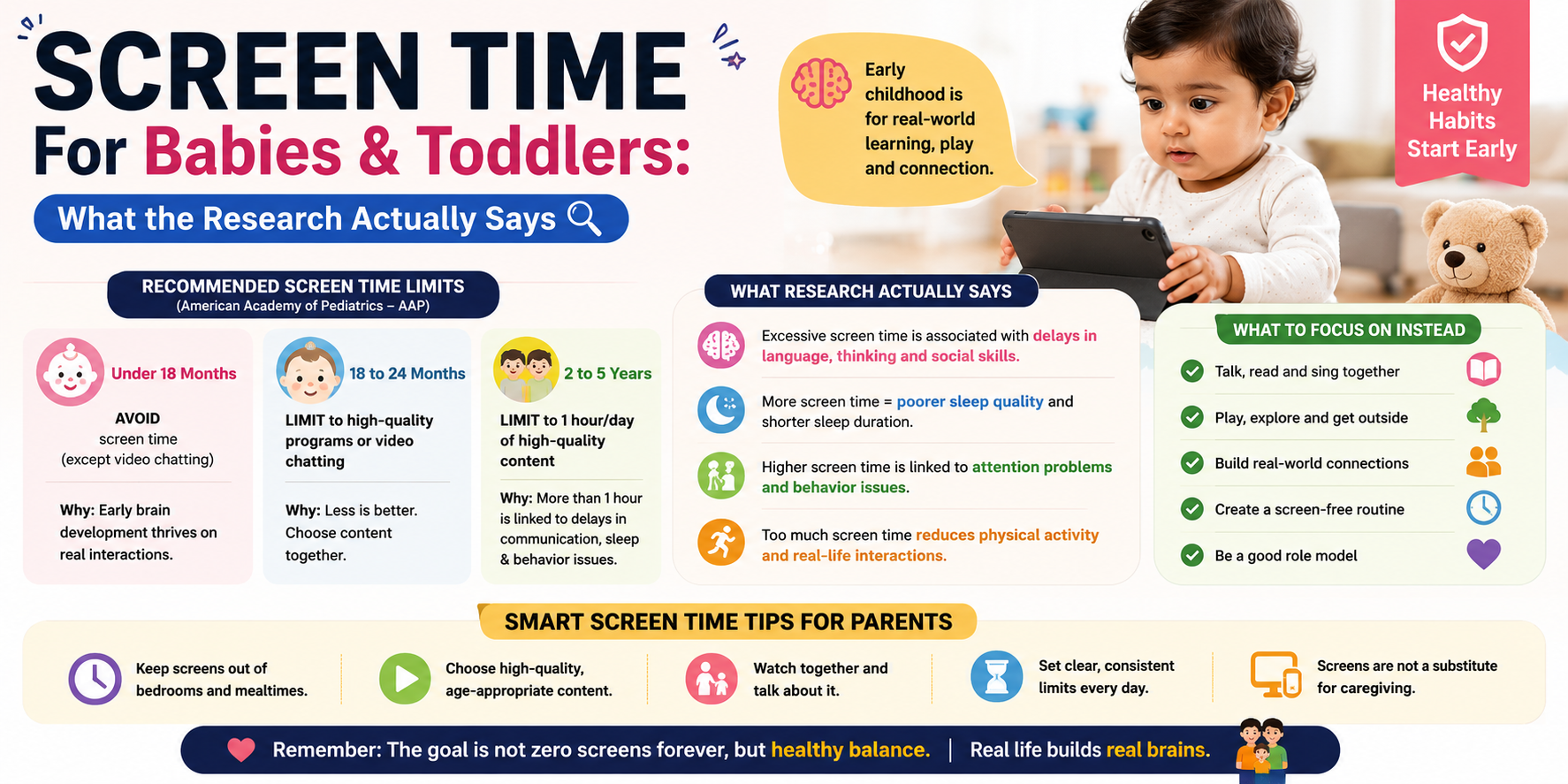
Both the World Health Organization (WHO) and the American Academy of Pediatrics (AAP) are clear on this age group:
Under 18 months: No screen time at all — with one exception: video calling. FaceTime with grandparents, a WhatsApp video call with a parent who's travelling — this counts as real human interaction and is fine. What doesn't count as fine is passive screen viewing: videos, YouTube, TV playing in the background, reels on a phone.
18–24 months: If you choose to introduce screens, it should be high-quality content only, and a parent or caregiver should watch with the child and talk about what's on screen. Passive solo viewing at this age offers very little developmental benefit.
The IAP (Indian Academy of Pediatrics) goes slightly stricter: no screen time at all under 2 years, and no more than one hour per day from 2 to 5 years — with less always being better.
The AAP's most recent 2026 guidance has evolved from strict time limits toward emphasising quality, context, and conversation — but the under-18-months recommendation remains firm: no passive screen time.
This isn't arbitrary. The first two years of life are when the brain is developing at its fastest rate — more synaptic connections are forming than at any other point in a person's life. What drives that development isn't stimulation from a screen. It's:
A screen delivers a one-way stream of stimulation. It can hold a baby's attention — the rapid cuts, bright colours, and sounds are specifically good at doing that — but it doesn't respond to the baby, doesn't read their cues, doesn't pause when they look away. The kind of learning that builds language and cognition in infancy requires that back-and-forth. A screen can't provide it.
Language and speech delay is the most well-documented effect. Toddlers who watch more than the recommended amount of screen time show slower vocabulary growth — and the reason makes sense: every hour in front of a screen is an hour not spent in conversation with a real person. One study found that infants who follow a caregiver's gaze to an object — a skill developed through face-to-face interaction — identified nearly 70% more words by 18 months than those who didn't. Screens don't teach gaze-following. People do.
Sleep disruption is the second major concern. Screens — especially phones and tablets — emit blue light that suppresses melatonin, the hormone that triggers sleep. Even background TV in the room where a baby sleeps has been shown to reduce sleep quality. For infants aged 6–12 months, evening screen exposure is associated with shorter nighttime sleep. Given how much of early brain development happens during sleep, this matters more than most parents realise.
Attention and behaviour. Preschool-age children who have two to three hours of screen time daily show higher rates of attention difficulties and behavioral problems. The theory is that the rapid pace of most screen content — short clips, quick cuts, constant novelty — sets an expectation for stimulation that ordinary life can't match, making sustained focus harder.
Displacement of what actually matters. Perhaps the most important effect isn't what screens do to the brain directly — it's what they replace. Floor time, tummy time, playing with blocks, listening to stories, babbling back and forth with a parent. These are the activities that build the developmental foundations. Screens crowd them out.
Video chatting is consistently treated differently in the guidelines, and it's worth understanding why. When a baby video calls a grandparent, the grandparent responds to the baby's expressions, pauses when the baby looks away, says the baby's name, reacts to sounds. There's a real person on the other end doing the developmental heavy lifting. That's not the same as watching a video, even if the screen looks identical.
So video calls — supervised, with a real family member or known person — are fine even before 18 months. A baby watching a YouTube nursery rhyme video is not the same thing, even if the parent is in the room.
It means your baby has a normally functioning brain. Young children are neurologically wired to be drawn to rapidly changing visual stimuli, bright colours, and high-contrast movement. That's why screens hold their attention — not because the content is developmentally valuable, but because it's designed to capture attention. The same reason adults find scrolling hard to stop.
The fact that a baby enjoys something doesn't mean it's good for their development. Babies also enjoy eating paper and pulling hair.
In Indian households, screens are often part of the environment in ways that aren't always deliberate — the TV on in the background all evening, elders watching news or serials while the baby is in the room, the phone passed around at family gatherings. Background TV is something the guidelines specifically flag: even when a child isn't "watching," ambient TV has been shown to reduce parent-child verbal interaction and disrupt play.
This isn't about guilt — it's about awareness. Reducing background screen exposure during playtime and mealtimes is one of the most effective and practical changes a family can make, without anyone having to give up their evening news.
During feeds: Talk to your baby instead of scrolling. This is one of the highest-value language-development windows of the day and it's free.
For the "I need five minutes" moments: A safe floor space with a few household objects — a spoon, a container, a soft toy — buys the same time as a screen and actually builds more. Babies are easily fascinated by things they haven't seen before.
Background TV: Try keeping it off during hours when the baby is awake and on the floor. You don't have to eliminate it entirely — just be intentional about when it's on.
For the hardest moments — meltdowns, travel, waiting rooms: Use screens as a last resort rather than a first response. They work, and sometimes that's what you need. The concern is when they become the default for any moment of difficulty.
If you do use screens: Sit with your child, name what's happening on screen, ask questions, pause it and talk. Co-viewing turns a passive experience into something closer to interactive, and it makes a real difference to what a child gets out of it.
My baby is 10 months and already watches TV every evening. Have I done damage?
No — and this question, asked with this level of concern, tells me you're paying attention. The evidence on harm is about patterns over time, not single exposures. If you reduce screen time now, during a period of rapid brain development, you are giving your child's brain exactly what it needs. The brain at this age is remarkably adaptable. Start now and it counts.
What about "educational" apps and baby learning videos — aren't those different?
Unfortunately, not significantly for under-2s. Multiple studies on "baby learning" DVDs and apps have found little to no language or developmental benefit in this age group. The learning that counts at this age happens in real interaction, not screen-mediated instruction. Save the apps for when they're older and can understand and interact with them meaningfully.
My toddler has a speech delay — could screen time be the cause?
Screen time is one contributing factor among several for speech delay, not a guaranteed cause. Some children with high screen time develop typically; others with low screen time have delays. If you're concerned about your child's speech development, the most useful next step is a developmental assessment — not just reducing screens, though that's a good idea regardless. I assess speech and language milestones at every developmental review in my clinic.
Is it okay if my baby watches while I'm in the room?
Presence helps, particularly if you're talking about what's on screen. But physical presence alone without interaction doesn't change the fundamental issue — passive viewing is still passive viewing. The more you talk, point, and engage during any screen time, the more developmental value you add.
What about when both parents are working and screens are genuinely needed?
This is real life, and the guidelines aren't designed to make working parents feel like failures. The goal is to be intentional about when and how screens are used — not to eliminate them under all circumstances. Prioritise screen-free time during the high-value windows: morning wake-up, mealtimes, and the hour before sleep. Everything else is contextdependent.
If you have concerns about your child's screen habits, speech development, or developmental milestones, these are things I assess routinely at well-child visits. Early review is always better than waiting.
I see patients every evening at my Chembur clinic — you're welcome to book a visit to talk through any developmental concerns.
I see patients every evening at my Chembur clinic — you're welcome to book a visit to talk through any developmental concerns.